
Insights
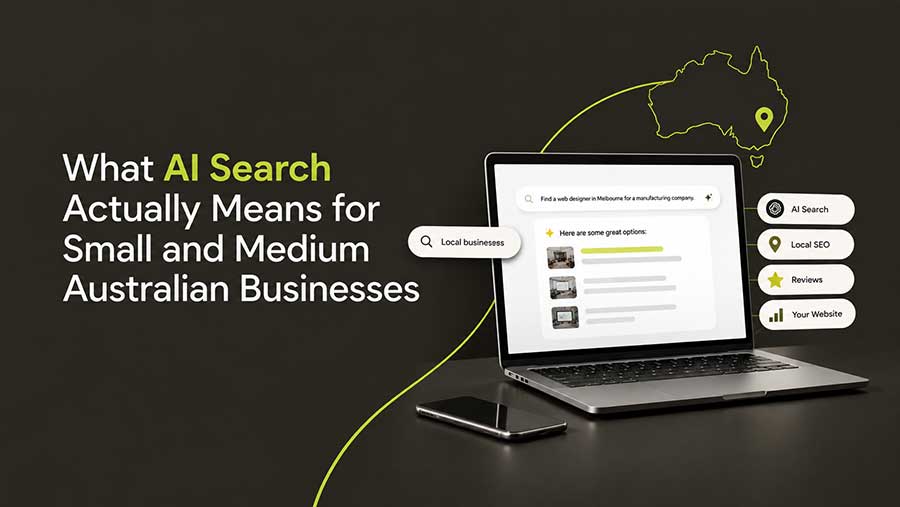
What AI Search Actually Means for Small and Medium Australian Businesses
Search is changing. For years, the basic formula was relatively simple: someone searched Google, saw a list of websites, clicked a link and made a decision.
That journey is becoming more complicated.
AI has now become part of how people discover businesses, research products and services, compare options and decide who to contact. Instead of simply searching for a keyword and clicking through a list of results, customers can ask an AI tool. They can pose a conversational question then receive a detailed answer based on information gathered from multiple sources.
So what does this actually mean if you run a small to medium-sized business in Australia?
It doesn't mean you need to become an AI company. It doesn't mean traditional SEO is suddenly irrelevant. And it certainly doesn't mean you need to throw away your existing marketing strategy. But it does mean the way customers find and evaluate your business is changing.
Your website still matters — perhaps more than ever
One of the biggest misconceptions about AI search is that websites are becoming less important.
The opposite is in fact true.
AI tools need reliable information to understand businesses, products and services. Your website remains one of the key places where that information is found.
The difference is that your website now needs to work for more than just a person looking at a page. It also needs to work for an AI agent.
It needs to clearly communicate:
- What your business does
- Who you help
- Where you operate
- What products or services you provide
- Why customers should trust you
- What makes you different
- How customers can contact or buy from you
A website full of vague marketing statements might look attractive, but it can be difficult for both people and search engines to understand. Clear, useful and well-structured content is becoming increasingly more important.
Being found is no longer just about ranking number 1.
Traditional SEO has often focused heavily on rankings. For example, a business might want to rank number 1 for:
"commercial electrician Melbourne"
That's still valuable.
But customers can now ask much more specific questions:
"Who are some experienced commercial electricians in Melbourne that work with large industrial facilities?"
The answer may not simply be a list of ten blue links.
AI will consider information from websites, business profiles, reviews and other online sources before presenting an answer. That means businesses need to think beyond individual keywords.
Instead of asking:
"What keywords do we want to rank for?"
it's worth asking:
"What questions would our potential customers ask before choosing us?"
Those questions should then be shaping your website content.
Your online reputation matters
AI search also reinforces something businesses have known for years: people want evidence before they buy.
Your website is only part of your digital presence.
Customers may also encounter:
- Google Business Profile
- Google reviews
- Industry directories
- Social media
- YouTube
- News articles
- Case studies
- Customer testimonials
- Industry associations
- Other websites mentioning your business
This creates a broader digital footprint.
A business with a good website but an outdated Google Business Profile, few reviews and inconsistent information across the web, is presenting a very different picture from a business with a strong, consistent digital presence.
Your reputation isn't controlled by your website alone.
Content needs to answer real questions
AI makes it easier than ever to produce large amounts of content.
That doesn't necessarily mean businesses need more content. They need better content.
For example, an accountant could publish dozens of generic articles about tax.
Or they could answer the questions their customers actually ask:
- "What can a small business claim as a tax deduction?"
- "Should I operate as a company or sole trader?"
- "What happens if I miss my BAS deadline?"
- "How does buying a vehicle through my business work?"
- "What records should I keep?"
This type of content can demonstrate expertise while also giving search engines and AI systems useful information about what their business does.
The opportunity isn't to publish an article every day. It's to become a genuinely useful source of information in your area of expertise.
Local businesses have an opportunity too
AI search doesn't only affect large national brands. It could be particularly relevant to local businesses.
Think about the types of questions people ask:
- "Find a web designer in Melbourne for a manufacturing company."
- "Who repairs commercial refrigeration equipment near me?"
- "What's a good family lawyer in Brisbane?"
- "Where can I get forklift servicing in Melbourne?"
These aren't traditional keyword searches. They're descriptions of a problem.
For a small business, this means your digital presence needs to make it very clear what problems you solve, who you solve them for and where you operate.
Your location, services, expertise, customer reviews and supporting content all contribute to that picture.
Don't ignore conversion
There's another important consequence of AI search. Getting discovered is only half the job.
Once someone arrives at your website, what happens next?
If your marketing successfully generates attention but the website is confusing, slow, difficult to navigate or doesn't make the next step obvious, you've potentially wasted the opportunity.
Your website should make it easy for visitors to:
Understand → Trust → Act
That might mean:
- Requesting a quote
- Booking a consultation
- Calling your business
- Making a purchase
- Downloading information
- Signing up for an email
- Starting a conversation
This is why SEO, AI search and website conversion shouldn't be treated as completely separate activities.
Getting traffic is useful. Getting the right people to take action is better.
Don't abandon Google Ads and other advertising
AI search doesn't mean paid advertising is going away either. Advertising remains an important way for businesses to put their products and services in front of potential customers.
In Australia, digital advertising continues to be a significant and growing part of the marketing landscape.
The more important question is how paid advertising works alongside your other channels.
For example:
Google Ads - can capture existing demand.
SEO and AI-search optimisation - can help build organic visibility.
Social media - can create awareness and engagement.
Email marketing - can nurture existing prospects and customers.
Your website - brings everything together.
The opportunity is to make these channels work together rather than treating each one as an isolated marketing activity.
Measurement becomes even more important
As the customer journey becomes less linear, measuring marketing performance becomes more challenging. Someone might first discover your business through Google, read an article several weeks later, see a social post, return directly to your website and eventually contact you.
Which channel generated the customer? There isn't always a simple answer.
This is why businesses should look beyond basic metrics such as clicks, impressions and website visits.
Where possible, connect marketing activity to meaningful business outcomes:
- Leads
- Enquiries
- Sales
- Revenue
- Cost per acquisition
- Conversion rate
- Customer lifetime value
The goal isn't simply to generate more traffic. It's to understand whether your marketing is generating business.
You don't need to do everything at once
For a small or medium-sized Australian business, this can all sound like a lot. The good news is that you don't need to completely reinvent your marketing strategy.
Start with the fundamentals.
1. Review your website
Is it clear what you do, who you serve and where you operate?
2. Review your content
Does your website answer the questions your customers actually ask?
3. Check your local presence
Is your Google Business Profile accurate and up to date?
4. Build credibility
Are you showcasing reviews, testimonials, case studies, qualifications and experience?
5. Improve conversion
Can someone easily contact you, request a quote or buy from you?
6. Check your measurement
Do you know which marketing activities generate enquiries and revenue?
7. Then look at AI
Once the fundamentals are right, start testing how your business appears in AI search tools.
- Search for your business.
- Search for your competitors.
- Ask questions your customers might ask.
- See what comes up.
You may learn more from doing this for 30 minutes than from reading dozens of articles about AI search.
The biggest change isn't technology — it's customer behaviour
The most important thing to understand is that AI search is ultimately not about technology. It's about how people find information.
Customers are becoming more comfortable asking questions rather than searching for individual keywords. They expect useful answers quickly. They compare businesses before making contact. And increasingly, technology is helping them navigate that process.
For small and medium Australian businesses, the fundamentals remain the same:
- Be visible.
- Be useful.
- Be credible.
- Make it easy to take the next step.
AI is changing the way people discover businesses, but businesses that already have a strong website, useful content, a credible reputation and good measurement are starting from a much stronger foundation.
The goal isn't to chase every new AI trend.
It's to make sure that when someone — whether a customer or an AI system — asks "Who can help me with this?", your business has a clear answer.
Need help reviewing your digital marketing?
At Flux Creative, we look at the bigger picture — your website, SEO, advertising, content, analytics and customer journey — to identify where your digital marketing can work harder for your business.
Want to see where your business currently stands? Book a conversation with Flux Creative.