
Insights
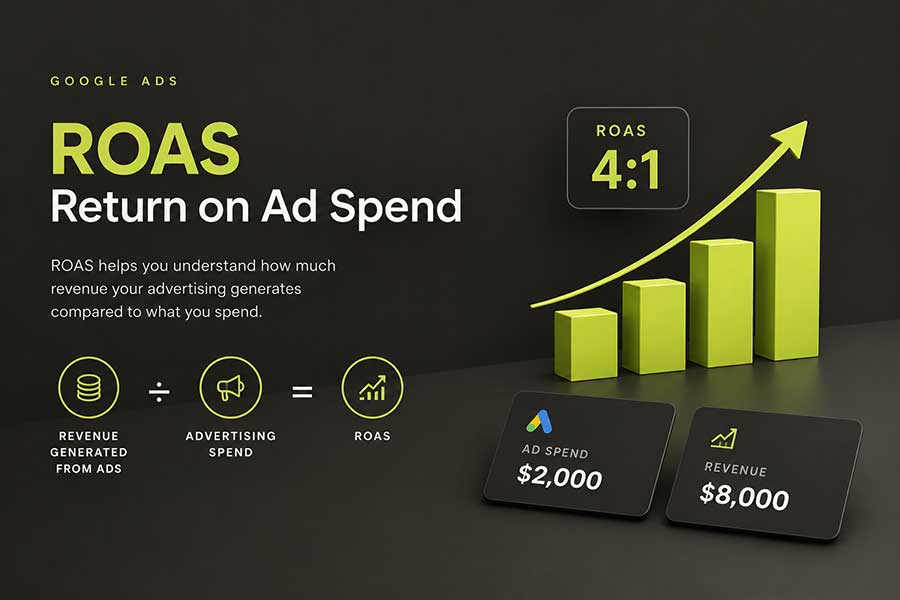
What ROAS (Return on Ad Spend) can you expect from Google Ads?
When investing in Google Ads, one of the most important questions is whether your advertising is generating a worthwhile return.
ROAS (Return On Ad Spend) is one of the key metrics used to measure this. It helps businesses understand how much revenue their advertising generates compared with the amount they spend, providing a useful indication of campaign performance.
However, there is more to evaluating advertising performance than simply looking at a ROAS number. What represents a good ROAS can vary significantly depending on your industry, profit margins, customer value and business model. Also advertising can deliver benefits that are not immediately reflected in ROAS, such as increased brand awareness, new audiences and future customers.
In this article, we look at how ROAS is calculated, what can influence it and what you can realistically expect from Google Ads.
What is ROAS - (Return On Ad Spend)
ROAS stands for Return On Ad Spend. It measures how much revenue you generate for every dollar you spend on advertising.
ROAS Formular
ROAS = Revenue generated from ads ÷ Advertising spend
For example:
- Google Ads spend: $2,000
- Revenue attributed to those ads: $8,000
ROAS = $8,000 ÷ $2,000 = 4
So your ROAS is 4:1, meaning you generated $4 in revenue for every $1 spent on advertising.
The margin of a product or service has a direct impact on the ROAS you need for your advertising to be profitable. A high-margin product or service can generally support a lower ROAS because there is more profit available to cover the cost of acquiring the customer.
In contrast, low-margin products require a higher ROAS to remain profitable, as a larger proportion of the revenue is absorbed by the cost of delivering the product or service.
ROAS with the broader value of advertising
ROAS is an important measure of advertising performance, but it is not the only benefit of running Google Ads. Advertising can also increase brand awareness and recognition, introduce your business to new audiences, generate website traffic, build remarketing audiences, grow email subscribers and encourage people to engage with your content.
Even when someone does not make an immediate purchase, repeated exposure to your brand can help build familiarity and trust, increasing the likelihood that they will choose your brand when they are ready to buy.
These longer-term benefits can be difficult to capture in a simple ROAS calculation but can still contribute significant value to your overall marketing strategy.
What ROAS can you expect?
ROAS can vary significantly between industries and business models.
The table below shows indicative ranges from a variety of industry sectors based on published Australian benchmarks and should be used as a guide rather than a guaranteed result. Your required ROAS ultimately depends on factors such as profit margins, customer lifetime value, average transaction value, competition and conversion rates.
| Industry / Business Type | Indicative ROAS |
|---|---|
| Lead Generation / Professional Services | 3–6x |
| Home Services / Trades | 4–8x |
| Legal Services | 5–10x |
| Healthcare / Medical | 4–8x |
| Real Estate | 5–10x+ |
| B2B Services | 3–7x |
| SaaS & Subscriptions | 3–5x |
| E-commerce – General | 2–5x |
| Fashion & Apparel | 2–3.5x |
| Home & Garden | 2.5–4.5x |
| Beauty & Health Products | 3–5x |
| Consumer Electronics | 3–6x |
| Automotive / Parts | 4–7x |
| Education | 2.5–5x |
| Travel & Hospitality | 3–6x |
| Informational / Content | 2x+ |
| Low-Margin Goods / FMCG | 2–3x |
Remember: a higher ROAS doesn't necessarily mean a more profitable campaign.
A business with a 20% gross margin needs a much higher ROAS to break even than a business with an 80% margin. For lead-generation businesses, it can also be more meaningful to measure cost per qualified lead, conversion-to-customer rate and customer value rather than relying on ROAS alone.
Summary
Ultimately, there is no single “good” ROAS that applies to every business. The right target depends on your margins, customer value, conversion rates, industry and overall marketing strategy.
If you would like to understand what a realistic ROAS could look like for your business and how to get more from your Google Ads, book a meeting with Flux Creative.
We can review your current marketing, website and advertising strategy and identify opportunities to improve your return.
PS: Yes, the image is AI generated ;-)